




 John E. Chapman Chief Executive Officer
As was discussed by Jeff DeHaan in his 2023 article and later reinforced by Kevin Nolte in 2024, the SECURE Act of 2019 along with the SECURE 2.0 Act of 2022 completely changed the landscape for beneficiaries of inherited, tax-advantaged accounts. In summary, the “stretch IRA” was replaced for most non-spouse beneficiaries with a 10-year distribution rule, which also requires many beneficiaries to take annual Required Minimum Distributions (RMDs) during years 1–9 if the original owner died after their required beginning date. Because of the uncertainty surrounding these rules, the IRS waived penalties for missed inherited IRA RMDs through tax year 2024, with annual RMD requirements generally beginning to apply in tax year 2025. Consider referring to Jeff’s article – Inherited IRA Required Distribution Rules Change, Again – for a deeper dive on the 10-year distribution rule as the rule itself did not change once codified under Title 26 of the Internal Revenue Code.
Now that the dust associated with the SECURE Acts has settled, the general focus has shifted from tax compliance to tax planning. This article compares proactive withdrawals – commonly referred to as “distribution smoothing” – with the default approach of withdrawing only the required amount in a given year, illustrating how each can affect taxes over the beneficiary’s distribution window. It also highlights the circumstances in which each strategy may be more advantageous, depending on factors such as the beneficiary’s income trajectory, age, and overall financial objectives.
Brief Background
The default distribution strategy simply focuses on complying with the 10-year distribution requirement. Under this approach, the beneficiary withdraws only the annual RMD during years 1–9 (when applicable) and defers any additional distributions until the tenth and final year, when the remaining account balance must be fully distributed. Rather than proactively managing the timing of taxable income, this approach is primarily intended to satisfy the statutory distribution requirements while preserving tax-deferred growth for as long as possible.
By comparison, a distribution smoothing strategy resembles withdrawals in excess of the annual RMD throughout the 10-year period. Strategically timed withdrawals are used to spread taxable income more evenly over multiple years, potentially reducing exposure to higher marginal tax brackets, Medicare Income-Related Monthly Adjustment Amount (IRMAA) surcharges, taxability of Social Security benefits, and other income-based phaseouts, with the primary tradeoff being fewer years of tax-deferred growth.
An Illustrative Example
Take a hypothetical individual – John – with the following circumstances:
- Age: 54
- Tax status: Married filing jointly
- Current salary: $185k
- Expected retirement: Age 65 (2037)
- Expected retirement income: Approximately $95k/year of pension income until claiming Social Security at age 67
- Inherited IRA balance: $800k
- Inherited from: Mother, who died after her required beginning date (making the account subject to annual RMDs and the 10-year distribution rule)
Figure 1, below, illustrates the tax outcome if John were to withdraw only the annual RMD during years 1 through 9 before liquidating the account in year 10. Vertical bars represent the couple’s income tax base while horizontal lines represent the relevant marginal tax brackets. The yellow star indicates the final year of the 10-year distribution period.
Figure 1: Default Distribution
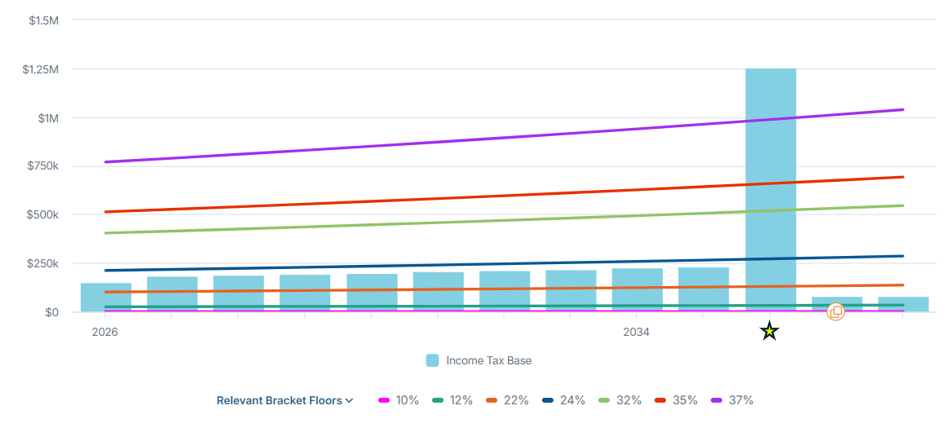
Figure 2, on the other hand, reflects the outcome if John were to intentionally withdraw $120k/year during years 1 through 9 before withdrawing the remaining balance in year 10.
Figure 2: Distribution Smoothing
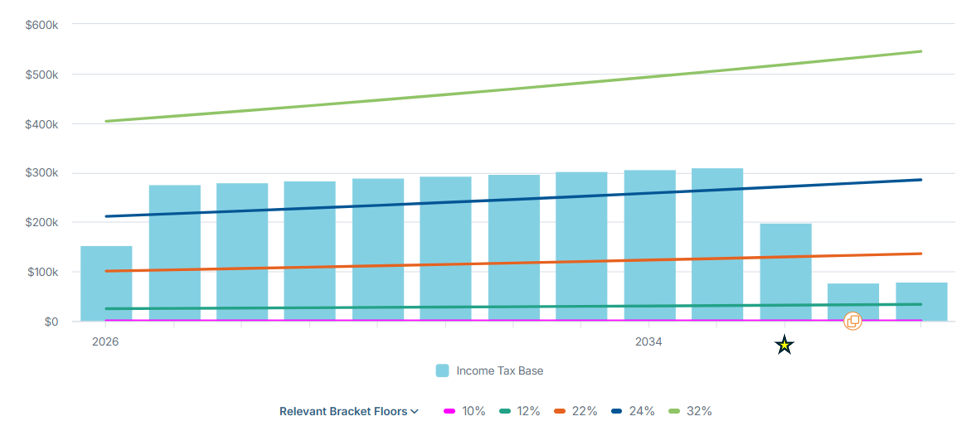
By taking larger distributions throughout the 10-year period rather than waiting until the final year, John is able to utilize lower marginal tax brackets, reduce the likelihood of a significant spike in income, and potentially lower his cumulative lifetime income tax liability. The lower income tax base in 2036 could also keep John below Medicare IRMAA thresholds, resulting in lower Medicare premiums when compared to the default distribution approach.
While this example illustrates circumstances in which smoothing distributions may be advantageous, the optimal strategy is highly dependent on the beneficiary’s unique tax situation and future income expectations. Beneficiaries with a slightly different fact pattern may instead benefit from taking only the required annual distributions and deferring larger withdrawals until later years. If you’ve inherited a tax-deferred retirement savings account and would like to learn more about how these strategies might apply to your specific case, please contact your advisor or the CCP Planning team.
20260728-1