




 John E. Chapman Chief Executive Officer
A bull market becoming more nuanced
July did not break the broader bull market narrative, but it did complicate it. Earnings have continued to provide an important fundamental anchor, inflation showed some moderation at the headline level even as underlying pressures remained above the Federal Reserve’s comfort zone, and the AI trade that had powered much of the market’s advance experienced a meaningful unwinding beneath the surface.
The result was not a wholesale deterioration in risk appetite so much as a market that became more selective, more sensitive to stretched valuations, and more discerning of the difference between good businesses and crowded trades. These have been consistent themes in our commentary throughout the year.
From divergence to dispersion
In the June Private Client Letter, my central point was that the economy was not inherently weak or strong, but both at once, with different sectors operating at different speeds. The Midyear Update carried that idea forward with the reference to a market running in “high gear with low visibility”. This meant that growth was resilient enough to support earnings but inflation, rates, and elevated valuations remained restrictive enough to narrow the margin for error.
July extended that same conversation, but with a different emphasis. What had been a divergent macro backdrop became a more dispersed market backdrop. Investors were no longer just weighing growth against inflation; they were also re-pricing concentration risk, capital spending, and the sustainability of some of the market’s most crowded winners.
Earnings are still doing most of the work
The most important continuity from the first half of the year is that earnings remain the market’s primary source of support. Our Midyear Update report highlighted that profits, not valuation expansion alone, were validating much of the advance in equities, with S&P 500 earnings growth expectations for 2026 having moved materially higher over the course of the year. In fact, because of the surge in earnings, the S&P 500 is about 10% cheaper at midyear than it was in January. The price-earnings multiple moved from over 22x to about 19.7x as markets became less forgiving toward stocks priced for perfection.
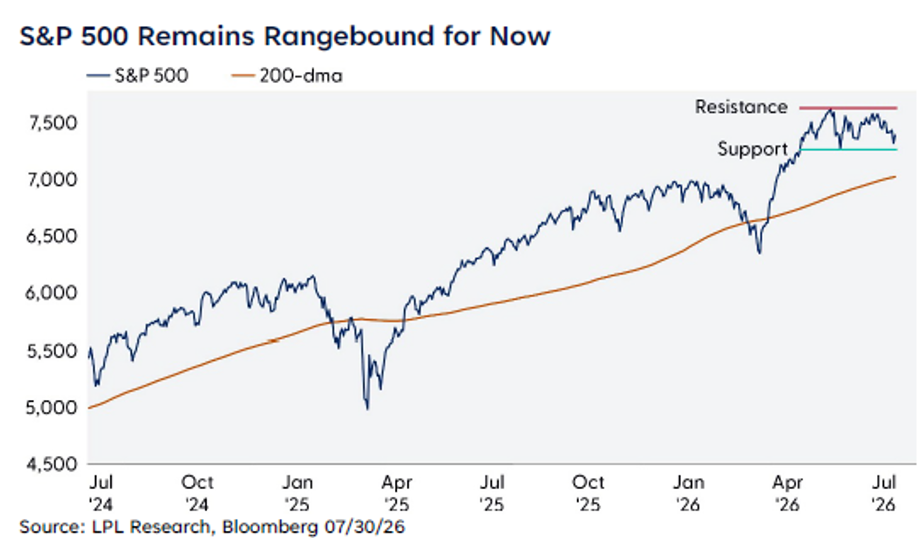
This distinction matters. When earnings are carrying the market, weakness in the most speculative or crowded pockets does not necessarily imply that the broader equity outlook has broken down. It may instead indicate that investors are becoming more disciplined about what they are willing to pay for future growth.
Inflation improved, but not enough to settle the question
Inflation data in July offered some welcome relief on the surface. The June CPI report showed a modest monthly decline and the annual rate eased to 3.9% from 4.2%, helped in part by lower gasoline prices. Even so, the broader message is that inflation has moderated rather than been defeated. We would note that core price pressures are still sticky enough to keep the Federal Reserve cautious.
This remains one of the defining investment tensions of 2026. Growth has been good enough to support profits, but not weak enough to produce a clean disinflationary trend or a meaningful reset lower in long-term yields. That is why the market continues to oscillate between confidence and caution: we readily see the fundamental strength, but we also have observed that the market can quickly become less forgiving of excesses.
The AI unwind was a positioning event, not a thesis-ending event
The most important market development of the month was the unwinding in parts of the AI trade. Semiconductor and other AI-linked infrastructure names sold off sharply during July. The reversal was amplified by heavy positioning, leverage, and elevated expectations after a remarkable first-half run. This was most vividly illustrated by the collapse of the highly leveraged hedge fund Situational Awareness.
Leopold Aschenbrenner, the former OpenAI researcher who became AI-world famous for his 2024 “Situational Awareness” essay, ran a hedge fund of the same name built around the thesis that AI would require massive buildout of chips, data centers, and power. The fund grew to roughly $45 billion by early July by reportedly using leverage as high as 400%. The AI trade violently reversed in late July, and the fund’s assets shrank to roughly $10 billion in a matter of weeks, even as the S&P 500 stayed near record highs.
This episode matters less because of the name involved and more because of what it revealed. Secular themes can remain valid while the securities most closely associated with them become temporarily over-owned, over-extended, or priced for nearly flawless execution. The lesson is not that artificial intelligence has ceased to matter; the lesson is that transformative themes do not exempt investors from the disciplines of valuation, liquidity, and position sizing.
Rotation within equities is broadening the opportunity set
One of the more constructive takeaways from July is that money did not simply leave equities; much of it rotated within equities. As some of the AI winners corrected, value stocks, small-cap value, real estate, and several more cyclical or income-sensitive sectors outperformed. Diversification matters and we have noted improving relative strength in financials, industrials, healthcare, and areas tied more directly to the real economy than to long-duration growth expectations alone.
That is a meaningful development for long-term investors. A market that broadens beyond a narrow set of mega-cap or AI-adjacent leaders is often healthier than one dependent on a single theme.
Investment implications
The discipline required now is slightly different from the discipline required earlier this year. In June, the challenge was to stay constructively invested despite contradictory macro headlines. In August, the challenge is to remain invested while also recognizing that leadership is becoming more nuanced, valuation matters more, and dispersion is creating both risk and opportunity at the same time.
For portfolios, that argues for several things. First, it supports participation in long-term secular growth themes, including AI and infrastructure, but with a greater sensitivity to concentration risk and a lower tolerance for crowded exposures. Second, it strengthens our long-standing case for diversification across sectors, styles, and asset classes. Rotation can preserve overall market progress even when the prior leaders pause. Third, it reinforces the value of quality in both equities and fixed income while the market continues to navigate the unresolved tension between resilient growth and incomplete disinflation.
Conclusion
None of this changes the larger message that has guided our portfolio strategy throughout the year. The tailwinds remain real: corporate profitability, innovation, capital investment, and the continued resilience of the U.S. economy. The turbulence remains real as well: persistent inflation, elevated interest rates, an uncertain geopolitical backdrop, and the upcoming midterm election cycle. As has been our perspective throughout 2026, this narrows the margin for error and periodic selloffs in the market’s most crowded trades should be expected.
Long-term wealth building still depends on the same discipline it always has: staying grounded in fundamentals, remaining diversified, and distinguishing between a durable thesis and an overextended trade.
Thank you for the trust you place in Clearwater Capital Partners. Please reach out to us should you have any follow-up questions or concerns. As always, it is our privilege to serve you and your family.
John E. Chapman
August 2026
20260803-3